An Idea for a Java Logic Engine
After years on the job, I have come to appreciate just how much design patterns matter. Used well, they make complex business logic flexible, polymorphic, extensible, and maintainable. So why not take it a step further—build a logic engine with design patterns baked in? This note is a record of that idea.
The Problem I Want to Solve
Backend business development has an awkward reality: a huge share of the code is the same skeleton repeated over and over—accept parameters, query data, branch on conditions, assemble a result, persist it. Every time, this flow gets written by hand. Developers who are good with design patterns abstract it nicely; those who aren't produce a giant tangle of if-else.
The problem isn't that developers don't understand design patterns. It's that every project has to re-implement factory, strategy, and friends from scratch, and the quality of those implementations varies wildly. If that layer of abstraction could be distilled into an engine, business developers would only need to care about the actual business logic.
The Core Idea
My vision: a UI-driven logic engine built specifically for backend Java developers, with design patterns baked into the engine itself. Developers just compose logic components, double-click a component to write SQL or Java code, pass component member variables between components, and finally persist to the database.
The principle is similar to today's Kettle tool—Kettle does visual orchestration of data extraction and transformation; this engine would do visual orchestration of business logic.
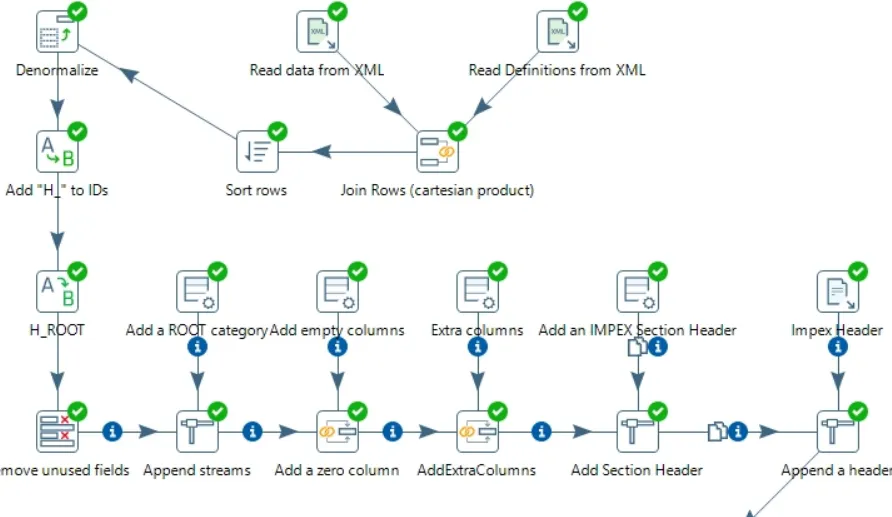
A component is the smallest logic unit, and each one does exactly one thing: a query, a validation, a computation, or a write. Complex business logic is just a flowchart of these units composed sequentially or conditionally. With a logic engine like this, Java development could shed a massive amount of repetitive work.
How Design Patterns Support It
The inspiration comes from a combination of patterns I actually use at work: factory, proxy, strategy, and decorator, plus the SPI concept. Each has its role in the engine:
-
Factory pattern: creates concrete logic component instances based on configuration. Every node dragged onto the UI is instantiated by the factory at runtime.
-
Strategy pattern: each logic component is a strategy implementation, so a given flow node can swap in different implementations without affecting the overall orchestration.
-
Proxy pattern: execution funnels through a proxy strategy class that handles cross-cutting concerns like parameter passing and exception handling, then forwards to the actual component.
-
Decorator pattern: layers capabilities onto a component without modifying it—wrapping a component with logging or caching, for example.
-
SPI concept: components expose themselves through an agreed interface. A new component just implements the interface and registers itself to be discovered by the engine—no changes to the engine's own code.
How It Runs
The whole flow is configuration-driven: the UI components generate a configuration file, and the configuration file tells the proxy strategy class which component logic unit's .class files to invoke. All logic strategies are loaded at system startup, making sure these Spring Beans are properly loaded into memory—the cost of class loading and bean initialization is paid at startup, so runtime is just table lookups and forwarding.
All subsequent execution goes through the proxy strategy class, which assembles each individual bean to complete a complex piece of business logic.
This design also honors the single responsibility principle and the open-closed principle: each component has one job, and new business features are added by creating new components and changing configuration, not by modifying existing code.
Relation to Low-Code Platforms
In today's market, the closest products to this idea are probably low-code or no-code platforms. But there's a difference in positioning: low-code platforms mostly target business users or full-stack scenarios and try to generate the pages too, while this idea targets only backend Java developers. It doesn't shy away from writing SQL and Java code—it just hands the orchestration and design-pattern skeleton over to the engine.
That's also why I think it's feasible: it doesn't chase "writing no code," only "writing no repetitive structural code."
Wrapping Up
This note is essentially an archive of an idea: combine factory, proxy, strategy, decorator, and SPI into a configuration-driven logic engine, replacing hand-written flow skeletons with visual orchestration. It doesn't need to become a sprawling platform. Even getting the "component + configuration + proxy strategy" mechanism working in a single project would be enough to validate the direction.
COMMENTS