Kata: A Secure Container Runtime
Traditional lightweight containers rely on Linux namespaces and cgroups for isolation. Along with being lightweight, simple, and efficient, this also brings security risks.
The risk of a shared kernel
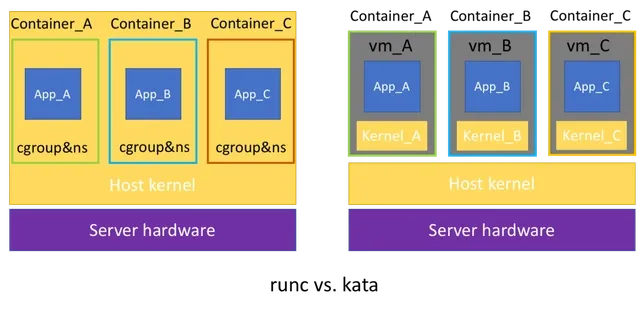
A container provides an execution environment whose resources are isolated from other processes on the system, but it shares the kernel with the host. If one container is compromised and the attacker manages to take down the host kernel, every other container inevitably crashes with it — the consequences are hard to overstate.
So is there a container technology that is both secure and reasonably efficient? That's where Kata containers come in.
Kata Containers - Open Source Container Runtime Software
How Kata approaches it
Kata actually isolates resources between containers by creating lightweight virtual machines, then running a container runtime inside each VM. Containers thus run on a dedicated kernel, gaining isolation of network, I/O, and memory, and can leverage hardware-enforced isolation via virtualization VT extensions. While providing this security, it still delivers high performance. Some performance is sacrificed (the current release has reached 3.0, with substantial performance improvements), but the benefit is obvious: a single container failing or being maliciously attacked can never affect the host, which indirectly protects the other running containers.
Source code
Github: https://github.com/kata-containers/kata-containers
Strengths
Kata Containers also has the following characteristics:
- Flexibility: Kata Containers runs across a variety of operating systems and container runtime environments. It supports multiple operating systems such as Linux, Windows, and FreeBSD, and is compatible with multiple container runtimes such as Docker, CRI-O, and containerd.
- Scalability: Kata Containers scales easily to large deployments. It integrates with container orchestration platforms like Kubernetes, making it possible to manage large numbers of containers.
- Easy installation: Installing Kata Containers is very straightforward. It can be installed through package managers (such as apt, yum, or zypper), and comes with a convenient command-line tool that helps users quickly configure and launch containers.
- Community support: Kata Containers has an active open source community maintained and advanced by developers around the world. The community provides documentation, tutorials, and support to help users better understand and use Kata Containers.
- Security: runs on a dedicated kernel, providing isolation of network, I/O, and memory, and can leverage hardware-enforced isolation with virtualization VT extensions.
- Compatibility: supports industry standards, including the OCI container format, the Kubernetes CRI interface, and traditional virtualization technologies.
- Lightweight: eliminates the need to nest containers inside full-blown VMs.
- High performance: delivers performance close to that of standard Linux containers (some overhead still exists).
Shortcomings
Some of Kata Containers' downsides:
- Performance loss: although Kata Containers' performance has improved substantially, it still carries some overhead compared to traditional Linux containers. This is because Kata Containers uses lightweight virtual machines to achieve container isolation, which adds extra cost.
- More complex installation and configuration: compared to traditional Linux containers, installing and configuring Kata Containers can be more involved. Users need to install and configure virtualization software such as QEMU and KVM, along with components like the Kata Containers runtime.
- Higher hardware requirements: Kata Containers requires hardware with virtualization VT extension support, which may limit its use on some older servers.
- A less mature ecosystem: while Kata Containers has an active open source community, its ecosystem may not be as mature as some other container technologies. That means users may need to write their own tools or plugins to meet specific needs.
Wrapping up
Kata's core idea is trading lightweight virtual machines for kernel-level isolation: each container runs on its own dedicated kernel, so compromising one container never spills over to the host or to other containers. The price is some performance overhead, a more complex installation and configuration process, and a requirement for hardware virtualization support. It isn't out to replace traditional containers — it offers a different trade-off. If your workloads involve multi-tenancy or demand strong isolation, enabling Kata for those workloads is worth it; otherwise, standard Linux containers remain the simpler choice.
COMMENTS