A Deep Dive into Netty
In distributed systems and microservice architectures, network communication is the most fundamental — and most important — building block.
Many high-performance frameworks (Dubbo, gRPC, RocketMQ, Elasticsearch, and others) rely on Netty underneath for their network communication.
When I first picked up Netty, I went straight to its API and example code — and got more confused the more I read. Why does EventLoop exist? Why are connections and reads/writes handled by two separate thread groups? It took me a while to realize that these designs didn't appear out of thin air; they exist to solve inherent problems in traditional network programming. Learning Netty while skipping this history is like memorizing answers without reading the questions.
So this post holds off on code and first sorts out the design ideas behind the NIO networking model that Netty is built on. Once you grasp this main thread, every Netty component falls into place.
The problem with traditional network programming
In early Java network programming, most programs used the BIO (Blocking IO) model.
BIO "blocks" in two places: accept() blocks while waiting for new connections, and read() blocks while waiting for data to arrive. Once a thread is blocked on a connection's read or write, it can't do anything else.
For example:
The server creates a new thread for every incoming client connection.
one connection = one thread
The upside of this model is that it's simple and intuitive to program — each thread only cares about its one connection, reading it from start to finish. With a small number of connections, it works perfectly fine.
But with many connections, say:
10,000 connections = 10,000 threads
several serious problems emerge:
Massive thread resource consumption
Threads themselves cost memory and scheduling overhead. Every Java thread occupies its own stack memory; with tens of thousands of connections, the thread stacks alone can eat a huge amount of memory — before even counting the OS's overhead for maintaining thread structures.
Heavy context-switching overhead
The CPU has to switch between threads constantly. Every switch means saving and restoring registers and flushing caches. When the thread count far exceeds the number of CPU cores, a significant share of CPU time goes into the switching itself rather than actual work.
Poor scalability
As connections pile up, the system becomes prone to collapse. What's more awkward: most of those connections are actually idle (in long-lived connection scenarios, most clients aren't sending data most of the time), yet each one hogs a thread that just sits there waiting — resources wasted on waiting.
So traditional BIO is simply not suited for high-concurrency network services.
The core idea behind NIO
To solve BIO's problems, Java introduced NIO (Non-Blocking IO).
The core idea of NIO is remarkably simple:
Manage a large number of connections with a small number of threads
The shift in thinking is this: since most connections are idle most of the time, don't have threads babysit connections. Instead, hand the job of watching "which connection has data" over to the operating system, and have threads step in only when an event actually occurs. This is the idea of IO multiplexing, which on Linux corresponds to system calls like select/poll/epoll.
It relies on three core components:
Channel
Buffer
Selector
Together they form the core architecture of NIO. Let's look at each in turn.
Channel
A Channel can be understood as:
a pipe for data transfer
Unlike traditional IO:
Traditional IO:
input stream / output stream
A Channel, however:
is bidirectional
It can both read and write. A Channel is essentially an abstraction of a network connection.
In Java NIO, the common implementations are ServerSocketChannel (listens on a port and accepts connections) and SocketChannel (represents a specific TCP connection). A Channel can be set to non-blocking mode — the prerequisite for being managed by a Selector: when there's no data to read, it returns immediately instead of stalling the thread.
Buffer
In NIO, all data must first pass through a Buffer.
Think of it as:
a temporary staging area for data
The data flow:
network -> Buffer -> program
program -> Buffer -> network
A Buffer is essentially a stateful region of memory, tracked internally by a few pointers — position, limit, capacity — that record "how far we've written, how far we can read". Switching between read and write modes requires methods like flip(), which is one of the reasons the raw NIO API is famously easy to get wrong. Netty later implemented its own ByteBuf largely to escape this awkward machinery.
Selector
The Selector is the most central component of NIO.
Its job is:
managing multiple Channels with a single thread
That is:
one thread
monitoring many connections
It works roughly like:
event polling
Concretely, when a Channel registers with a Selector, it declares which event types it cares about: a new connection arriving (ACCEPT), data readable (READ), ready to write (WRITE), and so on. The thread calls select() and blocks; as soon as any Channel becomes ready, the call returns the ready set and the thread processes them one by one.
The flow:
Selector
   |
monitors multiple Channels
   |
which Channel has an event
   |
process that one
This way, the thread spends all of its time "handling ready events" rather than "waiting on a particular connection" — which is precisely the fundamental difference between NIO and BIO.
The Reactor threading model
The Reactor threading model is a design pattern widely used in high-concurrency network servers. Its core idea: handle a large number of network connections with a small number of threads, driven by events. Instead of creating a dedicated thread per connection, threads listen for network events (connect, read, write, etc.) and process a connection only when data actually arrives on it. This avoids the resource consumption and context-switching problems of massive thread counts, dramatically improving a server's concurrent capacity.
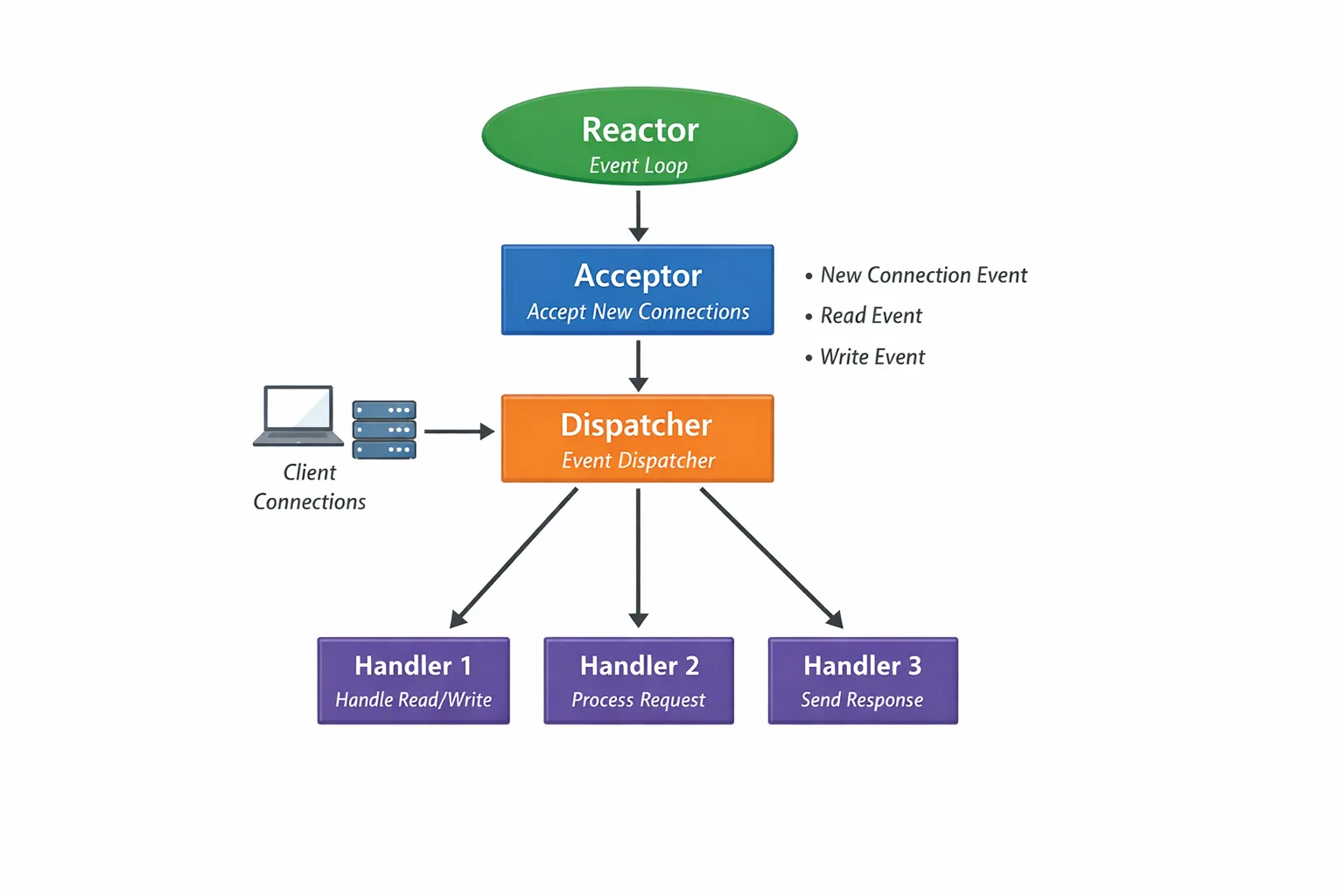
The Reactor model typically involves several key roles:
1. Event monitoring (Reactor)
Listens for network events, such as new connections arriving, data becoming readable, or the socket becoming writable.
2. Connection acceptance (Acceptor)
When a new client connects, accepts the connection and registers it with the downstream processing threads.
3. Event dispatching (Dispatcher)
Routes different network events to their corresponding handling logic.
4. Business processing (Handler)
Executes the actual business logic: parsing the protocol, handling the request, returning the result.
The Reactor model itself has evolved through several forms: single Reactor, single thread (one thread does both monitoring and processing); single Reactor, multiple threads (monitoring on one thread, processing handed to a thread pool); and master-worker Reactor (connection acceptance and read/write processing handled by separate Reactor thread groups). The higher the connection volume, the more important it is to separate acceptance from read/write so they don't drag each other down.
In Netty, the Reactor model typically shows up as the BossGroup + WorkerGroup thread structure, which maps exactly to the master-worker Reactor form:
- Boss threads: accept client connections
- Worker threads: handle network reads/writes and business logic
Through this design, Netty can handle tens of thousands of connections with a small number of threads — the core reason it achieves high-performance network communication.
Pitfalls and notes
A few things worth knowing up front when learning and using this model:
-
Never do slow work on a Worker thread. The Reactor model assumes event handling is fast. A Worker thread typically serves many connections; if a Handler runs a slow query or a synchronous remote call, every other connection on that thread gets stuck along with it. Time-consuming business logic belongs in a separate business thread pool.
-
Raw NIO APIs are very easy to get wrong. Buffer read/write mode switching and Selector event-handling details are full of traps — which is why real-world projects almost always choose Netty over hand-rolled NIO: it encapsulates all that complexity away.
-
NIO wins by saving threads, not by making individual IO faster. With very few connections, BIO isn't necessarily worse; the advantage of NIO/Reactor shows up when huge numbers of connections coexist. Choose your technology based on the scenario.
Wrapping up
To recap the main thread of this evolution:
- BIO's problem is "one connection, one thread" — threads sit wasted on idle connections;
- NIO uses Channel + Buffer + Selector to achieve IO multiplexing, letting a few threads handle only ready events;
- The Reactor model defines, on top of that, the division of responsibilities for event monitoring, dispatching, and handling;
- Netty's BossGroup + WorkerGroup is the production-grade implementation of the master-worker Reactor.
With this thread in mind, Netty's concrete components — EventLoop, Pipeline, ByteBuf — no longer look like designs that came out of nowhere. I'll cover Netty's core components and hands-on usage separately in a follow-up.
COMMENTS