Microservice Architecture Design
Once a monolith grows past a certain point, splitting it up becomes almost unavoidable. This post traces where microservice architecture came from, its core design principles and overall composition — and the new costs it brings along.
Why Microservices Emerged
In the early days of software, most applications used a monolithic architecture. Every functional module ran inside a single application process — the user system, order system, payment system, inventory system, and so on were all packaged into one project and deployed together. When the system is small, this is simple and direct, and development moves fast.
But as the business keeps growing, the problems of a monolith start to surface. The codebase balloons — a single project may contain hundreds of thousands or even millions of lines of code, and every change requires rebuilding and redeploying the entire system. Modules become tightly coupled, so a failure in one module can easily take down the whole application. And when traffic grows, you can't scale just the hot module — you have to scale the entire system, which wastes resources.
Against this backdrop, microservice architecture gradually became the mainstream design for large systems. The core idea is to break a massive system into multiple independent services, each owning a well-defined business capability that can be developed, deployed, and scaled independently. This reduces system complexity while improving maintainability and scalability.
Core Design Principles of Microservices
Microservice architecture is not just about chopping a system into many small services. What matters more is designing the system around business capabilities. Each service should have a clear boundary of responsibility and be able to run on its own.
Microservice design typically follows a few core principles:
- Single responsibility: each microservice owns one core business domain — a user service, an order service, an inventory service, and so on. This keeps responsibilities from blurring together and makes it easier to divide work across teams.
- Service autonomy: each microservice has its own database and data model; multiple services should never share a database. This reduces hard dependencies between services and keeps the system loosely coupled.
- Independent deployment: each service can be released and upgraded on its own without affecting others. This matters enormously for large teams and dramatically improves engineering velocity.
- Interface-driven communication: services talk to each other through APIs or messaging systems, never by reaching into each other's databases or sharing code libraries.
Together, these principles form the foundation of microservice architecture.
Overall Architecture of a Microservice System
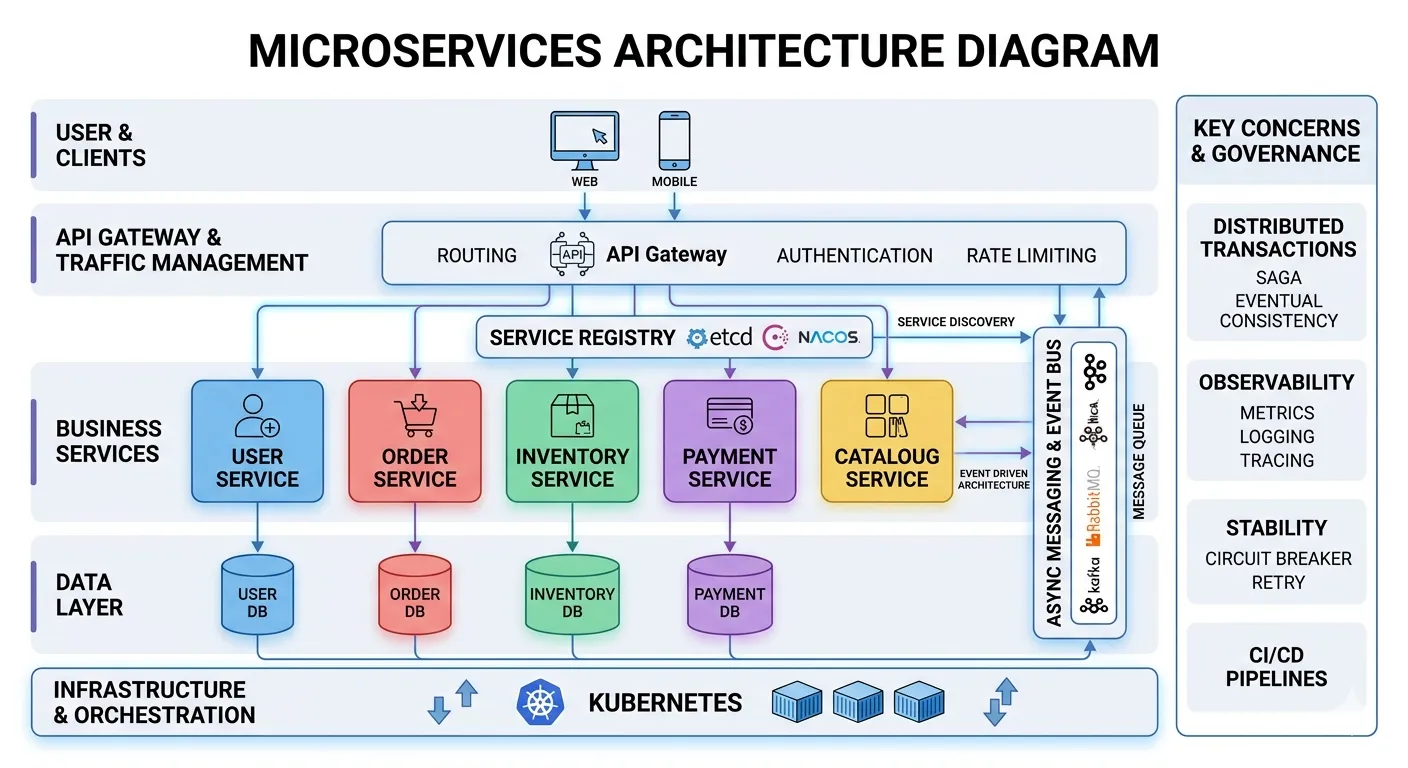
In practice, a complete microservice architecture is built from multiple foundational components — it's much more than just splitting up services.
At the outermost layer sits the API Gateway. As the unified entry point, the gateway handles client requests and provides authentication, rate limiting, logging, and routing. It hides the complexity of the backend services so that clients only ever face a single unified interface.
Behind the gateway is the business service layer, made up of the individual microservices — user service, order service, product service, payment service, and so on. Each service owns an independent business capability and interacts with others via API or RPC.
To let services find and talk to each other, systems typically introduce a service registry and discovery component such as etcd, Nacos, or Consul. Services register themselves on startup, and other services look up target addresses through the registry.
High-concurrency systems usually also introduce a message queue (MQ) for asynchronous communication — Kafka, RabbitMQ, or RocketMQ. Message queues help smooth out traffic spikes, decouple services, and build event-driven architectures.
On the data side, each microservice generally has its own database — MySQL, PostgreSQL, or a NoSQL store. For performance, Redis is commonly added as a caching layer to take pressure off the database.
Finally, the whole system typically runs on a container platform such as Kubernetes, using container orchestration for automated deployment, scaling, and failure recovery.
Key Design Questions in Microservice Architecture
For all its benefits, microservice architecture introduces new complexity of its own. Several key questions deserve close attention during system design.
1) Service Granularity
Split too coarsely, and you still end up with a large monolith; split too finely, and you drown in services and complexity. The usual advice is to draw boundaries along business domains, not technical modules.
2) Service Communication
Synchronous calls usually go over HTTP or gRPC, while asynchronous communication goes through message queues. In high-concurrency systems, heavy synchronous calling can create tangled call chains between services, so communication patterns need to be designed deliberately.
3) Distributed Transactions
In a monolith, database transactions guarantee data consistency. In a microservice architecture, each service has its own database, so traditional transactions no longer apply directly. The common solutions are eventual consistency, the Saga pattern, or a distributed transaction framework.
4) System Stability
More services means more points of failure, so mechanisms like rate limiting, circuit breaking, and graceful degradation become necessary — implemented via a service governance framework or a Service Mesh for traffic control.
Scalability of Microservice Architecture
One of the biggest advantages of microservices is elastic scalability.
In a traditional monolith, if one module becomes the bottleneck — say the order service is under heavy load — you have to scale the entire system. With microservices, you can scale just the order service, for example by adding instances behind a load balancer.
In cloud-native environments, Kubernetes can automatically scale service instances based on load: adding nodes during traffic peaks and scaling back down when traffic subsides, which greatly improves resource utilization. This on-demand elasticity makes microservices a natural fit for high-concurrency internet workloads.
The Challenges of Microservices
Microservices solve many problems, but they are no silver bullet. Compared to a monolith, a microservice system is significantly more complex:
- Higher operational overhead: a system may contain dozens or even hundreds of services, each with its own deployment pipeline and monitoring, which demands a mature DevOps platform.
- Service governance: as the number of services grows, the call graph between them becomes very complex and requires dedicated governance tooling to manage.
- Inherent distributed-systems problems: network latency, data consistency, service dependencies, and so on. These barely exist in a monolith but become first-class concerns in a microservice system.
So when a system is still small, a monolith is often simpler and more efficient — microservice architecture is better suited to medium and large systems.
Wrapping Up
At its core, microservice architecture reduces system complexity through service decomposition and autonomy, improving scalability and maintainability along the way. It lets the system grow flexibly with the business and enables teams to develop in parallel — which is exactly what large internet systems need.
But microservices are not a simple technology upgrade. They require supporting infrastructure: a service registry, an API gateway, a messaging system, monitoring, a container platform, and more. Only with this complete technical foundation in place can microservice architecture deliver its real value.
In real-world system design, architects need to weigh business scale, team capability, and system complexity to choose the architecture that fits — rather than chasing microservices for their own sake. Truly good architecture is not the most technically sophisticated option, but the one that strikes the right balance between complexity and payoff.
COMMENTS